Drawdown recovery math, and why an eval makes it worse
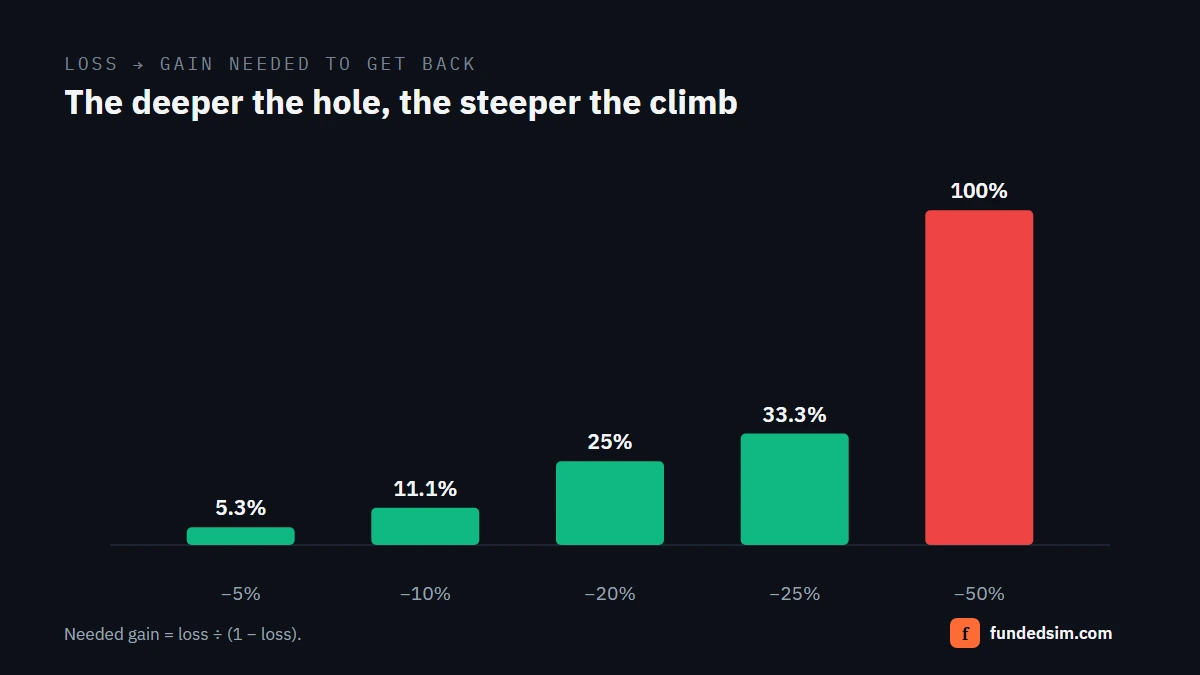
Losing 10% of an account needs an 11% gain to recover, losing 25% needs 33%, and losing 50% needs 100%. In a prop firm eval it's harder still: the trailing floor doesn't move down when you lose, so a losing week shrinks your room and recovering it doesn't give it back.
The percentages
| Loss | Gain needed to get back |
|---|---|
| 5% | 5.3% |
| 10% | 11.1% |
| 20% | 25% |
| 25% | 33.3% |
| 50% | 100% |
Needed gain = loss ÷ (1 − loss). The deeper the hole, the steeper the climb.
In an eval it's about room, not percent
Prop accounts are big on paper, so the percentages above look tiny. The real budget is the drawdown. On a 50K account with $2,000, that's the number that matters:
- Lose $1,000 and you've used half your room.
- Win the $1,000 back and your balance is where it was, but your floor is too, because a trailing floor only moves up from new highs. You're back to $2,000 of room, not ahead.
- Lose $1,000 after a $1,000 gain on day one, and your floor has moved up $1,000 already. You're at $1,000 of room with a flat account.
The practical rule
Protect the room before you chase the target. After a losing day, the next day's job is to not lose again, not to win it back. A smaller size the day after a loss is the cheapest insurance an eval has.
Blow it here, not on a paid eval
Run the same rules on your own trades in the simulator. Free, no card, and a blown account costs you nothing but pride.
Start practicing