Revenge trading: the trade after the loss
Revenge trading is taking a trade to win back a loss rather than because your setup is there. In an eval it's expensive twice: the second loss lands on the same daily loss limit, and both losses eat a trailing drawdown that won't move back down. The fix is a rule decided before the session, not willpower during it.
What it looks like
- The next entry comes faster than your setup usually allows.
- The size goes up "to get it back in one trade".
- The stop moves, or disappears.
- You're watching the P&L, not the chart.
If two of those are true, you're already in it.
Why it costs more in an eval
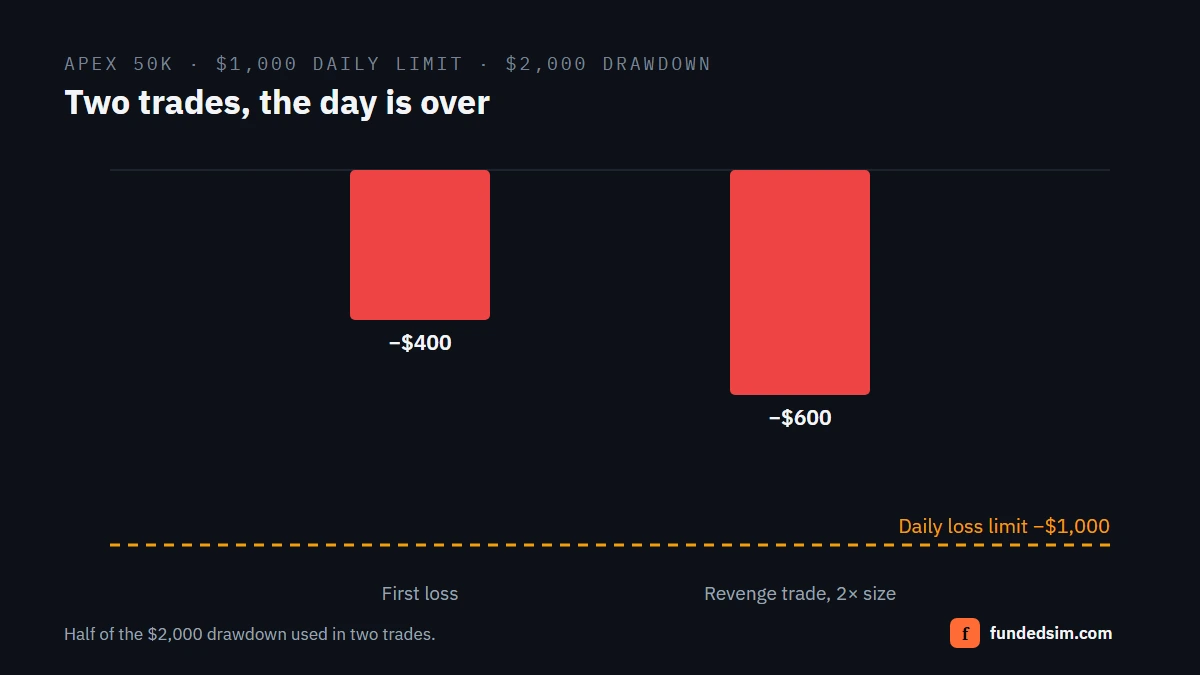
Take an Apex 50K with a $1,000 daily loss limit. First loss: $400. Revenge trade at double size with a wider stop: another $600. The day is done, the account is paused, and you've used half the $2,000 drawdown in two trades. On most days the original $400 loss was just a normal red day.
A rule that works because it's boring
Decide before the session:
- Two losing trades in a row ends the session. Not the day's limit. Two trades.
- Size never goes up after a loss on the same day.
- After a stop-out, wait a fixed time (15 minutes is common) before the next entry, and write down why you're taking it.
The point isn't the exact numbers. It's that the decision is made when you're calm, not after the loss.
Practice it where it's cheap
Run your rule in the simulator for a week and log every time you break it. That count is a more honest readiness check than your P&L.
Blow it here, not on a paid eval
Run the same rules on your own trades in the simulator. Free, no card, and a blown account costs you nothing but pride.
Start practicing